Thursday, February 21, 2013

876

876 = 2 x 2 x 3 x 73.

876 is a dodecagonal pyramidal number.

All the powers of 876 end with 376.

876 is 4020 in base 6. It is 727 in base 11, 525 in base 13, and 282 in base 19.


Source: What's Special About This Number?

Wednesday, February 20, 2013

1626

1626 = 2 x 3 x 271.

1626 is a centered pentagonal number.

1626 is the number of binary partitions of 31.

1626 is 2020020 in base 3.

1626 is a divisor of 296 - 1.


Source: What's Special About This Number?

Tuesday, February 19, 2013

691

691 is a prime number.

691 is the only known prime number that is a square when turned upside down (169) and another square when reversed (196).

691 is the smallest prime that can be written as the sum of thirteen consecutive primes.

691 is the (negative) numerator of the 12th Bernoulli number (-691/2730).


As conjectured by Ramanujan and proved by G. N.Watson, Ramanujan's tau function is divisible by 691 for almost all positive integers.

Source: Prime Curios!

Friday, February 15, 2013

921

921 = 3 x 307.

921 is 1110011001 in base 2 (binary). It is 32121 in base 4 and 333 in base 17.

921, 922, and 923 are each the product of two primes (A056809).

921 is the sum of nine positive fifth powers (A003354).

921 is the number of 10-digit numbers that are divisible by 510 (A151754).


Source: On-Line Encyclopedia of Integer Sequences

Thursday, February 14, 2013

1527

1527 = 3 x 509.

1527 has the representation  3 x 29 - 9.

1527 is the lower of a pair of consecutive happy numbers (A035502).

1527 is the sum of eight nonzero sixth powers (A003364).

The sum of the distinct prime factors of 1527 is a cube (A164788): 3 + 509 = 512 = 83.


Mathematician John Dee was born in the year 1527.

Source: On-Line Encyclopedia of Integer Sequences

Wednesday, February 13, 2013

2087

2087 is a prime number.

2087 and 2089 form a twin prime pair (A071698).

The reverse of 20879 is prime.

2087 is the sum of three distinct positive cubes (A122723).

2087, 28087, and 20887 are all primes (inserting the digit 8 between any two adjacent digits) (A217047).


2,087 is the number of working hours in a year for the purpose of salary conversion between annual salary and hourly rate.

Source: Prime Curios!

Tuesday, February 12, 2013

1426

1426 = 2 x 23 x 31.

1426 is the number of integer partitions of 42 into distinct parts.

1426 is a pentagonal number.

1426 is the smallest number n such that the sum of the divisors of n equals the product of the squares of the digits of n: 1 + 2 + 23 + 31 + 46 + 62 + 713 + 1426 = 2304 = 12 x 42 x 22 x 62.

1426 is 474 in base 18.

1426 is the sum of the totient function for the first 68 integers.


Source: Number Gossip

Monday, February 11, 2013

979

979 = 11 x 89.

979 is a divisor of 344 - 1.

979 is the sum of the first five fourth powers (A000538): 979 = 14 + 24 + 34 + 44 + 54.

979 is 454 in base 15 (A029970).

979 is the sum of 11 consecutive primes (A127338): 979 = 67 + 71 + 73 + 79 + 83 + 89 + 97 + 101 + 103 + 107 + 109.

979 is the sum of 11 positive fifth powers (A003356).


Source: What's Special About This Number?

Friday, February 8, 2013

2462

2462 = 2 x 1231. It is a semiprime with even digits (A108636).

2462 is a divisor of 5515 - 1.

2462 is the sum of 26 and the partition number of 26 (A133041).

2462 is the number of configurations of Sam Loyd's sliding block 15-puzzle that require a minimum of 10 moves to be reached, starting with the empty square at one of the eight non-corner boundary squares (A090165).

2462 and 24622 = 6061444 use only the digits 0, 1, 2, 4, and 6 (A136818).


Source: On-Line Encyclopedia of Integer Sequences

Thursday, February 7, 2013

2374

2374 = 2 x 1187.

2374 is the number of primes of the form 2k + 1 less than 105 (A001161).

2374 is a number that is not the sum of a triangular number, a square, and a fourth power (A115159).

2374 is the number of unit square lattice cells inside half-plane (two adjacent quadrants) of an origin-centered circle of diameter 79 (A136515).

2374 is the number of sums S of distinct positive integers satisfying S less than or equal to 31 (A026906).


Source: On-Line Encyclopedia of Integer Sequences

Wednesday, February 6, 2013

1742

1742 = 2 x 13 x 67. It is the first of a pair of sphenic twins (consecutive integers, each the product of three distinct primes (A215217).

1742 is a divisor of 293 - 1.

1742 is 2345 in base 9.

1742 is a number n such that 1 + n + n3 + n5 + . . . + n21 + n23 is prime (A125181).

1742 is a number whose product of digits (56) is four times the sum of the digits (14) (A062036).

1742 is the number of walks of length 6 on a square lattice that start from the origin and do not touch the nonpositive real axis once they have left their starting point (A053791).


In the year 1742, Christian Goldbach conjectured that every even number greater than or equal to 4 can be expressed as the sum of two primes.

Source: On-Line Encyclopedia of Integer Sequences

Tuesday, February 5, 2013

1719

1719 = 3 x 3 x 191.

1719 is the concatenation of the seventh and eighth primes (A045533 and A007795), a pair of twin primes, or two consecutive odd numbers (A032607).

1719 is the largest integer that cannot be written as the sum of squares of integers larger than 16 (A193018).

1719 is the sum of 11 non-zero 6th powers (A003367).

1719 is the smallest number expressible as a sum of 9 cubes (including 0) in 43 ways (A214725).


Source: On-Line Encyclopedia of Integer Sequences

Monday, February 4, 2013

616

616 = 2 x 2 x 2 x 7 x 11.

616 is a heptagonal number (A000566). It is also a tridecagonal number (A051865).

616 is a Padovan number (A000931).

616 is 211211 in base 3. It is 434 in base 12 (A029967).

616 is the sum of eight positive fifth powers (A003353).


Source: On-Line Encyclopedia of Integer Sequences

Friday, February 1, 2013

542

542 = 2 x 271.

542 is a member of the Fibonacci-type sequence starting with 3 and 8.

542 is 20132 in base 4 and 4132 in base 5. It is 392 in base 12 and 329 in base 13.

542 is the number of primes less than 104 having at least one digit 9 (A091710).

542 is the sum of no fewer than 17 fourth powers (A099591).


Source: What's Special About This Number?

Thursday, January 31, 2013

9000

9000 = 2 x 2 x 2 x 3 x 3 x 5 x 5 x 5.

9000 has two representations as a sum of two squares: 9000 = 302 + 902 = 542 + 782.

9000 is the index of a triangular number containing only three different digits.

9000 is a centered cube number.

9000 is the number of palindromes of length 8 (A050683).


The BFG-9000 is the most powerful weapon in the video game series Doom.

Source: What's Special About This Number?

Wednesday, January 30, 2013

992

992 = 2 x 2 x 2 x 2 x 2 x 31. It is the product of two consecutive numbers (a pronic number): 992 = 32 x 31.

992 is 1111100000 in base 2 (binary). It is 212 in base 22.

992 is the number of differential structures on the 11-dimensional hypersphere.

992 is the largest known even number that is expressible as the sum of two primes in only 13 ways.


Source: Number Gossip

Tuesday, January 29, 2013

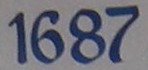
1687

1687 = 7 x 241.

1687, 1689, and 1691 are all semiprimes (A092125), the product of two primes.

1687 is 777 in base 15.

The last 1687 digits of 16871687 form a prime number.

1687 and its reversal 7861 are both multiples of 7 (A062901).

1687 is the sum of three consecutive hexagonal numbers (A129109): 1687 = 496 + 561 + 630.


Source: Prime Curios!

Monday, January 28, 2013

1509

1509 = 3 x 503.

1509 is the number of disconnected 2-regular graphs on 39 vertices (A165652).

1509 is a number n such that 2n + 1, 4n + 1, and 8n + 1 are all primes (A124041).

1509 is a pinwheel number, satisfying the equation 2n2 + 6n + 1 for n = 26 (A059993).

1509 is a number n such that 1 + n + n3 + n5 + n7 + . . . + n33 + n35 is prime (A124187).


Source: On-Line Encyclopedia of Integer Sequences

Friday, January 25, 2013

2225

2225 = 5 x 5 x 89.

2225 has three representations as a sum of two squares (A025313 and A000443): 2225 = 42 + 472 = 172 + 442 = 252 + 402.

2225 is the hypotenuse of two primitive Pythagorean triples: 22252 = 3762 + 21932 = 14962 + 16472.

2225 is a value of n where the sum of the nth powers of its digits are prime for n = 1 to 10: 21 + 21 + 21 + 51 = 11, 22 + 22 + 22 + 52 = 37, and so on.


Source: Prime Curios!

Thursday, January 24, 2013

491

491 is a prime number. It is a Sophie Germain prime (A005384) because 2 x 491 + 1 = 983 is also prime.

491 is a prime number with distinct, nonprime digits (A034844) in English consecutive order: four, nine, one. Each digit is also a square.

It is conjectured that 491 is the smallest prime not of the form x3 + y3 + 2z3.

491 is the smallest number n such that the largest prime factors of the numbers n through n + 4 decrease.


Source: Prime Curios!

Wednesday, January 23, 2013

547

547 is a prime number.

547 is a centered hexagonal number (or hex number) and a centered heptagonal number.

The number of primes between 6! and 7! is itself prime. 547 is the smallest odd prime to enumerate the primes between n! and (n + 1)! for any n.

547 is the smallest number that cannot be written using 11 copies of 11 and the operations +, -, x, /.

547 is 202021 in base 3 and 20203 in base 4. It is 4142 in base 4.


Source: Prime Curios!

Tuesday, January 22, 2013

343

343 = 7 x 7 x 7.

343 = (3 + 4)3.

342343 + 343342 is prime.

343 is the sum of the first five odd Fibonacci primes: 343 = 3 + 5 + 13 + 89 + 233.

343 can be expressed using the first six odd primes: 7(3 + 5 + 11 + 13 + 17).

343 + 656 = 999 = 323 + 676.

343 is 1331 in base 6 and 292 in base 11.

343 = 180 + 181 + 182.


The Willow Grove exit on the Pennsylvania Turnpike started out as exit 27 (the cube of an odd prime). With a change in exit numbers, Willow Grove is now exit 343, another cube of an odd prime.

Source: Prime Curios!

Friday, January 18, 2013

2413

2413 = 19 x 127.

2413 is a divisor of 206 - 1.

2413 is a hexadecagonal number (A051868).

2413 is a semiprime that is the sum of two positive cubes (A085366).

The difference between 2413 and its reversal, 3142, is a nonzero cube (A061923): 3142 - 2413 = 729 = 93.


Source: On-Line Encyclopedia of Integer Sequences

Thursday, January 17, 2013

918

918 = 2 x 3 x 3 x 3 x 17.

918 is a number that does not have any digits in common with its cube (773620632).

918 is 646 in base 12.

The sum of the digits of 918 (18) is a substring of 918 (A052018).

918 is the smallest number that is 51 times the sum of its digits (A003634).


Source: On-Line Encyclopedia of Integer Sequences

Wednesday, January 16, 2013

871

871 = 13 x 67.

871 = 4! + 5! + 3! + 6! + 1! and 45,361 = 8! + 7! + 1!

871 is 31213 in base 4.

871 is a central, polygonal number (A002061). It is also a tridecagonal number (A051865).

871 has the representation 2533 + 7.

871 is a divisor of 662 - 1.


Source: On-Line Encyclopedia of Integer Sequences

Tuesday, January 15, 2013

587

587 is a prime number.

587 is the smallest number whose sum of digits (20) is larger than that of its cube (5873 = 202262003; 17).

587 is the number of 10-smooth numbers up to 105. An integer is 10-smooth if all its prime factors are less than or equal to 10.

Add 587 zeros between the 9 and the 7 in the prime number 97 to obtain a 589-digit prime.

587 is the sum of five consecutive primes: 587 = 107 + 109 + 113 + 127 + 131.


Nickel Plate Road No. 587 (at the Indiana Transportation Museum) is an example of a United States Railroad Administration light Mikado steam locomotive.

Source: Number Gossip

Monday, January 14, 2013

2351

2351 is a prime number. It is a Sophie Germain prime because 2 x 2351 + 1 = 4703 is also prime.

23512351 ends in the digits 2351.

There are 6907 digits in 2351! Note that 6907 is prime.

2351 is in the middle of a sequence of 17 consecutive primes whose sum is also prime: 2293 + 2297 + . . . + 2351 + 2393 + 2399 = 39971 is prime and 17 is prime.

2351 is the sum of all three-digit Fibonacci numbers.


Source: Prime Curios!

Friday, January 11, 2013

988

988 = 2 x 2 x 13 x 19.

988 is the maximum number of pieces into which 18 cuts can divide a cube (A000125).

988 is the sum of four consecutive primes (A034963): 988 = 239 + 241 + 251 + 257.

988 is the number of walks of length 6 on a square lattice, starting at the origin, staying on points x greater than or equal to 0 and y less than or equal to x (A060900).

988 and the 988th prime (7817) have only one digit in common (A107939): 8.


Source: What's Special About This Number?

Thursday, January 10, 2013

853

853 is a prime number.

853 is formed from three consecutive Fibonacci numbers, in reverse order.

853 divides the sum of the first 853 prime numbers (2615298).

853 is the number of connected graphs with seven vertices.

853 has a representation as a sum of two squares: 853 = 182 + 232.

853 is the hypotenuse of a primitive Pythagorean triple: 8532 = 2052 + 8282.

853 is the start of the smallest string of five consecutive cousin prime pairs.


The Transamerica Pyramid, the tallest skyscraper in San Francisco, has a structural height of 853 feet.

Source: Prime Curios!

Wednesday, January 9, 2013

670

670 = 2 x 5 x 67.

670 is an octahedral number (A005900).

670 is a sum of composite numbers between successive primes (A054265).

670 is the number of ways of making change for 57 cents using coins of 1, 2, 5, 10, 20, and 50 cents (A001313).

670 is the sum of 15 but no fewer nonzero fourth powers (A046046).


Source: What's Special About This Number?

Tuesday, January 8, 2013

972

972 = 2 x 2 x 3 x 3 x 3 x 3 x 3.

972 is the largest number for which the absolute difference between any two digits of the number is always prime.

972 is an Achilles number, which is powerful in the sense that each prime factor occurs with exponent greater than one but imperfect in the sense that the number is not a perfect power.

972 is the sum of four positive fifth powers (A003349): 972 = 35 + 35 + 35 + 35.


Source: Number Gossip

Monday, January 7, 2013

747

747 = 3 x 3 x 83.

747 is 456 in base 13.

747 is the sum of distinct factorials (A059590): 747 = 6! + 4! + 2! + 1!

747 is the number of ways to tile a 4 x 7 region with 1 x 1 and 2 x 2 tiles (A054854).


The Boeing 747 is a larger commercial airliner.

Source: On-Line Encyclopedia of Integer Sequences

Friday, January 4, 2013

2153

2153 is a prime number.

2153 is the sum of five consecutive composite numbers (A060330): 2153 = 428 + 429 + 430 + 432 + 434.

2153 has a representation as a sum of two squares: 2153 = 282 + 372.

2153 is the hypotenuse of a primitive Pythagorean triple: 21532 = 5852 + 20722.


In 1977, Akio Suzuki used primes ranging from 53 to 2153 to construct the magic cube with the smallest possible magic sum (for cubes with side three and distinct prime entries).


Source: Prime Curios!

Thursday, January 3, 2013

2040

2040 = 2 x 2 x 2 x 3 x 5 x 17.

2040 is a number that can be expressed as the difference of the squares of primes in exactly four distinct ways (A092000).

2040 is the sum of a twin prime pair (A054735): 2040 = 1019 + 1021.

2040 is the number of ways of writing 13 as a sum of six squares (A000141).

2040 is the sum of 12 consecutive primes (A127339): 2040 = 139 + 149 + 151 + 157 + 163 + 167 + 173 + 179 + 181 + 191 + 193 + 197.


Source: On-Line Encyclopedia of Integer Sequences

Wednesday, January 2, 2013

936

936 = 2 x 2 x 2 x 3 x 3 x 13.

936 is an octagonal number (A000567) and a pentagonal pyramidal number (A002411).

936 is 12221 in base 5.

9363 = 820,025,856 = (820 + 02 + 58 + 56)3.

936 has a representation as a sum of two squares: 936 = 62 + 302.

936 is a number that can be expressed as the difference of the squares of primes in just one distinct way (A090781).


Source: What's Special About This Number?

Monday, December 24, 2012

2013

2013 = 3 x 11 x 61.

2013 is a permutation of the digits 0, 1, 2, and 3  (A203569)

2013, 2014, and 2015 have the same number of divisors (A005238). Each is the product of three distinct primes (A066509 and A113789).

The digital sums of 2013 in base 2 (11111011101), base 3 (2202120), and base 5 (31023) are equal (A135121).

The sum of 2013 and its prime factors equals the sum of 2014 and its prime factors (A020700): 2013 + 3 + 11 + 61 = 2014 + 2 + 19 + 53 = 2088.

2013 is the number of trees with 27 nodes and 4 leaves (A055291).


The year 2013 celebrates the Mathematics of Planet Earth.


2013 is also the International Year of Statistics.

Friday, December 21, 2012

931

931 = 7 x 7 x 19.

931 is the sum of three consecutive prime numbers: 931 = 307 + 311 + 313. It is also the sum of 11 consecutive primes (A127338).

931 is 777 in base 11 and 111 in base 30. It is 2500 in base 7.

931 is a divisor of 303 - 1.

931 is a central polygonal number (A002061).

931 is a number that is the sum of exactly three sets of Fibonacci numbers (A122195).


Source: On-Line Encyclopedia of Integer Sequences

Thursday, December 20, 2012

719

719 is a prime number. It is a Sophie Germain prime because 2 x 719 + 1 = 1439, also a prime.

719 is a number that can be expressed as both a factorial prime (6! - 1) and as an abundant number less 1.

719 is the number of rooted trees with 12 vertices.

719 is a right-truncatable prime number: 719, 71, and 7 are all primes.

719, 197, and 971 are all primes.


The hour and second hands of an analog clock align 719 times every twelve hours.

Source: Prime Curios!

Wednesday, December 19, 2012

1234

1234 = 2 x 617.


1234 is the smallest four-digit number with increasing digits (A007908).


1234 is the number of digits in the 12th Fermat number (A057755).

1234 is 103102 in base 4. It is 14414 in base 5 and 5414 in base 6.

1234 is the number of ways to place three nonattacking bishops on a 3 x 8 board (A172207).


1234 has a representation as a sum of two squares: 1234 = 32 + 352.


Source: What's Special About This Number?

Tuesday, December 18, 2012

541

541 is a prime number. It is the 100th prime.

541 is a centered dodecagonal number. It is the 10th hexagonal star number.

5! + 4! + 1 = 145, the reverse of 541. 541 is the only odd number greater than 1 with this property.

541 is the number of orderings of five objects with ties allowed.

541 has a representation as a sum of two squares: 541 = 102 + 212.

541 is the hypotenuse of a primitive Pythagorean triple: 5412 = 3412 + 4202.

541 has the representation 541 = 29 + 29.


Source: Number Gossip

Monday, December 17, 2012

1000

1000 = 2 x 2 x 2 x 5 x 5 x 5. 1000 is a perfect cube.

1000 can be expressed using the first three primes: 23 x 53.

The 147th prime (853) plus 147 equals 1000.

2999 + 1239 is the smallest 1000-bit prime.

1000 is 2626 in base 7. It is 1331 in base 9.

1000 has two representations as a sum of two squares: 1000 = 102 + 302 = 182 + 262.


T-1000 was the shape-changing robot from the 1991 film Terminator 2: Judgment Day.

Source: Prime Curios!

Friday, December 14, 2012

1672

1672 = 2 x 2 x 2 x 11 x 19.

1672 is 767 in base 15.

1672 is a number that can be expressed as the difference of the squares of primes in just one distinct way (A090781).

1672 is a multiple of 8 that has a digit sum that is a multiple of 8 (A216997).

On an 8 x 8 chessboard, there are 1672 3-step knight's tours summed over all choices for the starting position (A186441).

1672 is the number of obtuse isosceles triangles on a 10 x 10 grid (geoboard) (A190318).


Source: On-Line Encyclopedia of Integer Sequences

Thursday, December 13, 2012

797

797 is a prime number.

797 is a left- and right-trunctable prime number that yields the primes 7, 79, and 97.

797 is the smallest number and the smallest prime n such that googol - n is prime.

797 is the number of functional graphs on 9 vertices.

797 has a representation as a sum of two squares: 797 = 112 + 262.

797 is the hypotenuse of a primitive Pythagorean triple: 7972 = 5552 + 5722.

797 is 665 in base 11 and 565 in base 12. It is 494 in base 13.


Source: Number Gossip

Wednesday, December 12, 2012

395

395 = 5 x 79.

395 is the sum of three consecutive primes (A034961): 395 = 127 + 131 + 137. It is also the sum of five consecutive primes (A034964): 395 = 71 + 73 + 79 + 83 + 89.

395 is the smallest multiple of 5 with a digit sum of 17 (A069534).

395 is the smallest sum of 5 consecutive odd primes that is a multiple of 5 (A132810).

395 is the sum of 15 but no fewer nonzero fourth powers (A046046).


Source: On-Line Encyclopedia of Integer Sequences

Tuesday, December 11, 2012

533

533 = 13 x 41.

533 is the number of degree sequences for graphs with five vertices.

533 has two representations as a sum of two squares: 533 = 22 + 232 = 72 + 222.

533 is the hypotenuse of two primitive Pythagorean triples: 5332 = 922 + 5252 = 3082 + 4352.

533 is 201202 in base 4. It is 191 in base 19.

533 is the sum of three consecutive primes: 533 = 173 + 179 + 181. It is also the sum of five consecutive primes: 533 = 101 + 103 + 107 + 109 + 113.


Source: What's Special About This Number?

Monday, December 10, 2012

885

885 = 3 x 5 x 59.

885 is a divisor of 584 - 1.

885!/588! - 1 is prime.

885 is an enneagonal pyramidal number (A007584).

885 is 31311 in base 4 and 311 in base 17. It is 531 in base 13.


Source: Prime Curios!

Friday, December 7, 2012

595

595 = 5 x 7 x 17.

595 is the 34th triangular number (the sum of the first 34 integers).

595 is a centered nonagonal number.

595 is the number of ways to tile a 3 x 18 rectangle with 3 x 1 rectangles.

595 is 151 in base 22.


Source: Whar's Special About This Number?

Thursday, December 6, 2012

996

996 = 2 x 2 x 3 x 83.

996 has a square (992016) formed by inserting a block of digits inside itself (A045953, A046829), A046851, and A086457).

The sum of the squares of the first 996 primes is a prime (A098561).

996 is the number of cubic lattice walks that start and end at the origin after 6 steps, not touching the origin at intermediate stages (A049037).


Source: What's Special About This Number?